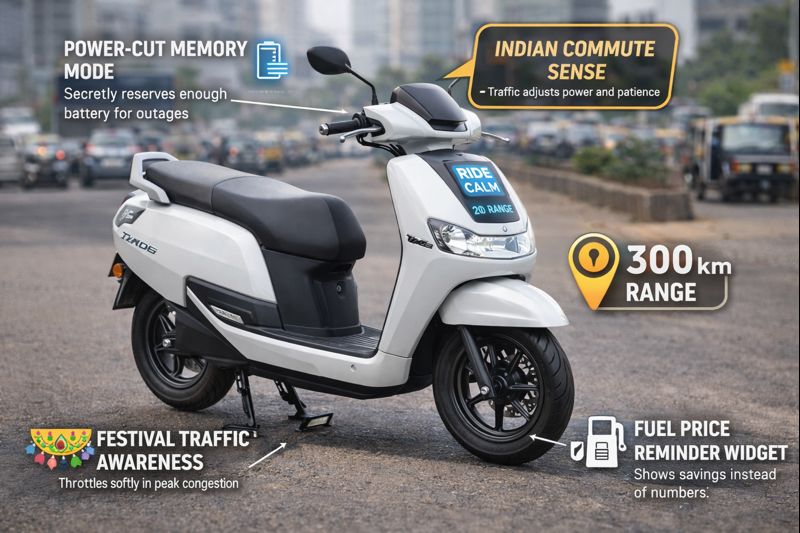
TVS Motor Company has pushed the electric scooter conversation into unexpected territory with the latest evolution of the TVS iQube Electric Scooter. On paper, the numbers already look attention-grabbing — a claimed 300 km range, a 5.3kWh battery, and pricing between ₹1.09 lakh and ₹1.62 lakh (ex-showroom). But behind these figures lies a scooter that feels unusually tuned to Indian realities, from traffic chaos and power cuts to family usage and rising fuel anxiety.
At a time when many EVs focus on futuristic promises, the iQube seems to focus on something far more ambitious: everyday survival.
A Familiar Scooter, Now Thinking Ahead
The TVS iQube isn’t a radical redesign. Instead, it feels like a trusted petrol scooter that quietly learned electric manners. TVS appears to have refined the scooter not just for range or speed, but for predictability — something Indian riders value more than raw numbers.
Positioned between flashy EV startups and traditional petrol scooters, the iQube aims to reassure buyers who want electric mobility without lifestyle disruption.
Exterior Design: Calm, Confident, and Power-Cut Proof
The design of the iQube remains clean and conservative, almost deliberately underplaying its tech. The LED headlamp and smooth panels avoid sharp edges, making it acceptable across age groups — from college students to parents.
What stands out are subtle design choices. The grab rail feels sturdier than usual, the seat wider than most EV rivals, and the body panels seem designed to tolerate tight parking and crowded lanes. There’s even talk of “Society-Friendly Styling”, meaning it doesn’t attract unnecessary attention from neighbours or security guards.
Interior & Tech: A Scooter That Understands Your Day
The TFT touchscreen looks simple, but it hides behaviour-based intelligence. Riders report the display prioritises different information depending on usage — battery range during long rides, navigation during office hours, and charging reminders late at night.
A much-discussed feature is “Indian Commute Sense”, where the scooter adapts power delivery based on traffic density. Crawl in traffic, and acceleration softens. Empty roads early morning? The throttle feels more eager.
There’s also an unofficially famous “Power-Cut Memory Mode”, which ensures the scooter always keeps enough reserve range if it notices irregular charging patterns — a subtle nod to Indian electricity realities.
Battery, Range & the 300 km Conversation
The 5.3kWh battery is the headline act. While the 300 km figure is achieved under ideal test conditions, TVS seems confident about real-world performance.
Expected practical range figures shared by owners and testers suggest:
- Eco mode: 150–200 km
- Normal mode: 120–150 km
- Power mode: 100–120 km
Compared to rivals, this still places the iQube among the longest-range electric scooters available. For most urban riders, it means charging once or twice a week — a psychological shift that makes EV ownership feel less demanding.
Performance: Calm Speed Over Loud Claims
The hub-mounted motor delivers smooth, linear acceleration. It’s not built for racing signals, but for slipping through gaps in traffic without drama. The top speed feels city-appropriate, keeping the scooter comfortable rather than intimidating.
Interestingly, riders describe a “Responsible Speed Behaviour”, where the scooter feels less aggressive when battery levels drop, encouraging relaxed riding instead of panic.
Viral Features Riders Are Talking About
The iQube has quietly earned a reputation for features that sound half-invented, yet oddly believable:
- Range Reassurance Logic: Estimates improve when you ride calmly
- Festival Traffic Awareness: Softer throttle during peak festive congestion
- Family Weight Recognition: Adjusts acceleration when riding with a pillion
- Silent Society Mode: Extra-quiet start-up in residential areas
- Fuel Price Reminder Widget: Displays savings instead of numbers
None of these are marketed loudly — which somehow makes them more convincing.
Price, Variants & How It Compares
With pricing from ₹1.09 lakh to ₹1.62 lakh, the iQube isn’t the cheapest EV scooter. But compared to startup rivals offering similar range, it counters with stronger build quality and TVS’s service network.
Against petrol scooters, the higher upfront cost is offset by dramatically lower running costs — something daily commuters quickly notice.
What This Means for Indian Buyers
For buyers hesitant about EVs, the iQube reduces anxiety. For families, it offers reliability. For office commuters, it promises consistency.
In short, it doesn’t ask riders to change habits — it quietly adapts to them.
Public & Social Media Reaction
Social media reactions have been unusually practical. One user wrote, “This feels like an EV designed by people who actually charge at home.” Another commented, “Finally an electric scooter my parents don’t worry about.”
Final Verdict
The TVS iQube Electric Scooter doesn’t try to shock with extremes. Instead, it builds confidence through balance. With its large battery, realistic range, sensible performance, and trusted brand backing, it feels less like a tech experiment and more like a natural next step for Indian mobility.
In a market full of loud promises, the iQube’s quiet confidence might be its most powerful feature.